Showing posts with label Museums. Show all posts

Monday, 9 June 2014

Thomas Coram's Foundling Hospital

When I booked to see Neil Gaiman and Tori Amos at the British Library, I saw that there was another event, involving Dave McKean performing some of his own music, and happily there were 2 performances, one on Friday evening, and one on Saturday evening, so I was able to book for the Saturday without having to book a day off work.

I got a train up to London, around midday on Saturday. The Dave McKean event wasn't until 6.30, so I had a few hours in London, and I decided to go to a museum I've not previously visited, The Foundling Museum, which is close to the British Library.

The museum is on the site of Thomas Coram's original Foundling Hospital - Coram was a sea captain, who became appalled at the sight of children abandoned and dying on the streets of London, and who campaigned to get a Royal Charter in order to set up a foundling hospital. He wasn't particularly well connected, and it took him 17 years to get what he needed, but he got his Royal Charter signed by George II in 1739, and founded a ' Hospital for the Maintenance and Education of Exposed and Deserted Young Children

The hospital was so popular that they had to introduce an application process, and parents were encouraged to leave a token to allow them to identify their child if they were ever able to return to reclaim them. 


The museum has a lot of the tokens on view - some serve to illustrate how poor the parents were - there are little twists of ribbon, beads, even playing cards. There are also more distinctive tokens - a bone fish (probably a gambling token) and a medallion which was a season ticket for Vauxhall pleasure gardens.

The children were given new names when they were admitted, and (if not reclaimed by their parents) were apprenticed once they became old enough, with a view to them becoming productive members of society.

Coram may not have started with much in the way of influence or connections, but he managed to achieve both - William Hogarth became a Governor of the hospital, and designed its coat of arms, and the original uniforms, as well as donating art works. 

Handel supported it, conducting charity concerts, including performances of his 'Messiah' Oratorio there, to benefit the hospital, and remembering it in his will. 

As well as information and exhibits relating to the history of the hospital, the museum has a lot of art - the current displays include copies of Hogarth's Rake's Progress' etchings, together with modern interpretations and reflections of similar themes, by David Hockney, Yinka Shonibare, Jessie Brennan and Grayson Perry

It made for an interesting, thought-provoking, and occasionally heart-breaking afternoon. 

The Coram organisation still works with children and  their families, although they no longer run children's homes directly. And the museum is well worth visiting, if you have the opportunity.

Wednesday, 16 October 2013

More Fun - With Museums and Romans and Squid

After lunching at the Savoy*, I decided to go to see London's Roman Amphitheatre, which is underneath the Guildhall in the City. As an added bonus, they are currently having a  exhibition of |Victorian Inspired modern Art - Victoriana.


The museum is in a newer part of the building - and when they were putting in the foundations, back in the 80s, they discovered the remains of a Roman Amphitheatre (as one does). And so they kept it there, in the basement, and built the rest of the new gallery over the top.

I have to admit that, as Roman Amphitheatres go, it's not hugely impressive, as the pieces which are left are only about 12 inches tall, (although there are some wooden drains, which is quite impressive) but i love the idea of it being there, under the Guildhall. and they have made an effort with the presentation, with lots of wireframe impressions of what the structure would likely have been like, to give you a sense of scale.

The Victoriana exhibition was a completely different kettle of fish. Sadly they would not allow photographs, so I can't show you - but there were pieces by Grayson Perry and Jake and Donos Chapman, there was a wedding cake made entirely from hair, a modified Victorian engraving of a woman with tentacles instead of legs) and  my favourite piece, one by Tessa Farmer, which features her trademark skeletal fairies, riding bees and butterflies, and armed with hedgehog spines, attacking a Victorian marble statue. It was beautifully disturbing.

Contrast: New and Old
Then there was the portrait of the lady with a squid instead of a face, a wonderful set of Alphabet prints and some original art from Alan Moore's 'The League of Extraordinary Gentlemen'.

Great stuff.
The following morning I decided to go back into the City, to visit the Museum of London, and in particular their exhibition of the Cheapside Hoard.

Before going to the museum I wandered around a little, enjoying the contrast of modern and not-so-modern London. And just near to the Museum I found a little garden called Postman's Park, which is the site of "G.F.Watts' Memorial to Heroic Self Sacrifice".

Apparently, Watts was a successful Victorian artist, who painted portraits of many of the great and the good (or at least the successful) and came to believe that ordinary people who behaved in heroic ways should also be remembered, and set up the memorial to do so. The memorials are all tiled plaques - the earliest ones designed by de Morgan, the later ones by Royal Doulton - and although the project stopped after Watts' wife dies in the 1930s, there is one much more recent memorial, to a gentleman who died in 2007, saving a child from drowning.  Despite the sometimes florid wording of some of the plaques, it's a moving place. I had it almost to myself.

The museum visit was interesting - the Hoard itself was discovered by workmen in 1912, and is believed to have been buried in the late 17th Century - it consists of hundreds of uncut jewels and pieces of jewellery from the 16th and 17th Cs, and may have been the stock in trade of a local goldsmith. There are some amazing pieces - long, intricate gold and enamel necklaces, carved jewels, a tiny pocket watch set in a single emerald, numerous brooches and pins - there was high security and one could not take photographs, but the museum has some here.


I also made a whistle-stop tour of the rest of the museum, which has exhibits ranging from the remains of prehistoric beasts, to remnants of Roman Londinium, Viking artefacts, through to medieval pilgrim badges, medieval tiles still stained with soot from the Great Fire of London, right through to  some of the costumes from the Olympic opening ceremony.

Oh, and the Lord Mayor's Coach.

And a Dalek.

I would have liked to stay longer, but I had a party to get to.Which is pretty good, as reasons to leave go!


(*Please note the oh-so-casual name drop)

Monday, 9 September 2013

A Grand Day Out

My weekend in London continued with a visit to the Museum of Childhood, mostly on the basis that it was close to m hotel, and looked as if it might be interesting, which it was, although I would have enjoyed it more had there been slightly more information about the exhibits (It's obviously designed to be very child friendly, which is fine, but I'm sure most children come with adults attached, who might appreciate a little more information!

I really liked this model theatre, which made me think of the (Other) Miss Spink and Miss Forcible, and also found the exhibition of children's clothes interesting.

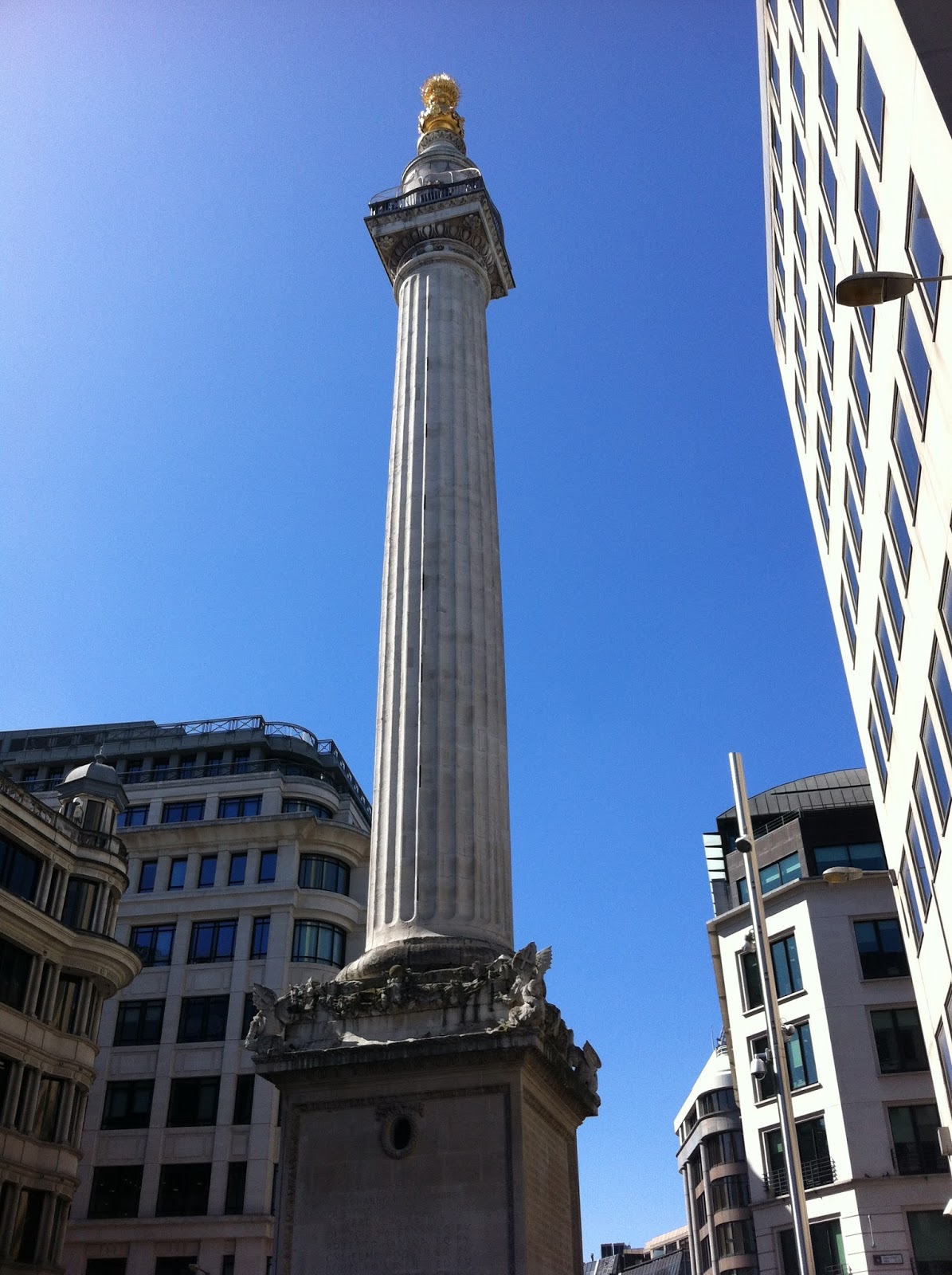
Later in the day I found myself getting off the tube at Monument,  due to  closures on the Northern Line, and decided to go above ground just because I can't recall having ever visited the Monument before; it is right by Pudding Lane, and is a monument memorialising the Great Fire of London. It was designed by Wren,and it is possible to climb up inside and look out over London from the top, so I did.

The Monument is just over 200 feet tall, and there are 311 steps, and it is quite a trek up to the top! It is, however, worth the effort.


There are views out over central London in all directions, and one can play 'spot the landmark' looking for St Paul's Cathedral, Tower Bridge, the Shard, and many others.

When I walked back down again, I sat in Pudding Lane and read a little more about the monument, learning that it was completed in 1677, and that it stands 202 feet tall, and exactly 202 feet from the site, in Pudding Lane, where the fire started.

It made for an interesting early afternoon interlude, before heading out to spend the rest of the afternoon and evening with relations.

The weekend concluded with a lovely party at Mike & Sue's house, with lots of lovely people to chat with, music from the talented Mr Mitch Benn, and some fantastic food. Sadly, I had to leave before the end of the party, due to the need to get back to Paddington to get my train home, and by the time I got home I was absolutely exhausted (I'm not as young as I was, and all these busy days and fun nights out take it out of me:-) )

It was a highly satisfactory weekend.


Sunday, 21 July 2013

Manchester, Museums and Macbeth: Part 1

I have just returned from a very enjoyable weekend in Manchester, visiting my brother and his girlfriend. They'd contacted me a little while ago to invite me, and to suggest that I come up this weekend which is the final weekend of the Manchester International Festival, and we could, they suggested, go to see the outdoor screening of a live broadcast of Kenneth Branagh and Alex Kingston's 'Macbeth'. (the live performances are in a small, deconsecrated church, and cost £65 a ticket, and sold out very fast, so that was never an option!)

It was also an opportunity for me to see R & J, and to see their new home.

I had a very hot and sticky drive up on Friday evening, but was greeted with mojitos, which is the proper way to deal with such trips!

Cotton Mill machines
On Saturday, after a leisurely and tasty breakfast, we visited the Museum of Science and Industry, which I haven't visited for about 6 or 7 years. They have some interesting exhibits about the cotton industry (which of course was one of the big industries in Manchester)

(replica of0 'Baby', the world's 1st stored-program computer, built in 1948
They also have exhibits relating to the history of computing, Manchester University having been at the forefront of early computing, and flight - the first closed-cockpit plane was built in Manchester.

However, the area where we spent the most time was the engine sheds - and (unlike on my previous visits) they had their replica of Stephenson's 'Planet' running.


The original engine was built in 1830, and was the first locomotive to be built in large numbers, rather than as a prototype- this replica was built by enthusiasts in the 1990s.

We decided that it would a shame to turn down the opportunity of a train-ride ( although I think we may have been the only passengers not accompanied by at least one small child!)

As the museum is housed in a disused station/ station yard, the tracks 'Planet' runs on run parallel to the lines still in use, running to and through Deansgate station, so you can wave at the trains as they pass!

A lot of the other steam-engines (most of them industrial, rather than locomotive engines) were also running, so the shed was full of the lovely smell of steam-engines, and rather warm.

So, logically, our next step was to find some of the best ice-cream on the planet, from the wonderfully named Ginger's Comfort Emporium ice-cream van, which was located in Albert Square, heart of the Manchester International Festival. I have to say, her 'Chorlton Crack' (salted caramel and peanut butter) was delicious, as was the coconut and lime, and i regret living so far from Manchester, which will severely limit my opportunity to sample more flavours!

Later in the day, after a very late lunch/early super, we visited another part of the Festival, a piece called 'This Variation', by Turner Prize nominee Tino Sehgal, at the Mayfield Depot.

The depot is a now-derelict railway depot, and the empty space we walked through to get to the Sehgal exhibit was actually quite striking.

'This Variation' however, was .... odd. And not a little disturbing. You walk into pitch darkness, surrounded by sounds - songs without discernible words, the thump of ?bare feet, people you can't see brush past you, and it's all rather strange and disturbing.

We did not stay long.

And so to Macbeth, which I think I'll give a post of it's own.