Showing posts with label History. Show all posts

Monday, 27 March 2023

The Ceremony of the Keys, Tower of London

 So, on Friday evening I was in London to go to the Ceremony of the Keys , at the Tower of London. 

Photo of a castle (the tower of london) at night
The Tower of London by Night

The Tower of London is of course the worlds best known combined bird house and safety deposit box, housing, at it doesn, some very pampered ravens and the Crown Jewels. 

There was a Roman wall and other structures there (and there are still some remains of the Roman wall nearby, by the Underground Station) , the WIlliam the Bastard had a castle built there in 1066, in the style known, I believe, as 'Come and have a go if you think you're hard enough, Saxon losers'. Various other bits and pieces have been added since, mostly between the 11th and 16th Centuries. It's still officially a Royal Palace (although not a Royal Residence)  and of course is ope as a tourist attraction during the day. 

Sing reading 'Ceremony of the Keys - Ticket Holders Only PLease  wait here

However, after it is closed for the night, you can still, if you have snagged a ticket, attend the ceremony of the keys. THis is something (the ceremony, not the ticketed attendance) which has been going on for the last 700 years. Allegedly, King Edward III turned up unannounced at the Tower one evening in 1340 and was able to walk in, unchallenged, and was a bit miffed at the lack of proper security (Presumably it did not occur to him that, just possibly, someone did recognise him and decided that demanding that the King explain what he was doing snaking into his own castle at night was not a wise career move) 

Anyway, he apparently decreed that the fortress must be properly locked up at sunset, and unlocked in the morning. It's not recorded whether he also made any rules about putting the cat out.

And so, ever since, there has been a ceremony every night (as far as I can tell, the unlocking in the morning is rather less formal!) 

The Duke of Wellington, who was the Constable of Tower in 1826, changed the timing to provide for the ceremony to take place at 10 p.m. every night, rather than 'sunset', and that's what's happened ever since. (It was slightly delayed once in 1940 when a bomb fell on the tower, but hasn't been missed)

Phot shows 4 guardsmen, 2 carrying guns,  in bearskin hats flanking 2 beefeaters
You aren't allowed to take photos, so this one is from the official website

You have to book ahead - the tickets are only £5.50 each but there are only a relatively small number, and they have to be booked in advance.

I arrived at the Tower at about 9.15 - the tickets are very firm that you must be on time, and no latecomers will be admitted, so I wanted to be sure I was a bit early. So, there was a bit of hanging about outside the (locked) gares, then just before 9.30, a Yeoman Warder (Beefeater) wearing a long, red, 'guard coat' (rather than the tudor dress you see in the Yeomen in when they are on duty in the day) came up to the gate to let us in, ticking us all off on a list, and we were then let in through the gates. I think there were maybe 30-40 of us.

'Our' Yeoman then explained that we were not permitted to have phones on or to take photos during the ceremony, before taking us across the moat and giving us a brief history ot the tower and then an explanation of the timing and sequence of the ceremony, before leading us further in.


We were then let further in, where we waited by Traitor's Gate and he went off with a bunch of keys..

Then a group of four soldiers showed up, from the inner ward - One (1) officer with drawn sword, 2 (2) normal soldiers with big guns, and one (1) drummer (with no drum) there to carry a lantern, which contains a candle, because dammit, just because the place has multiple electric lights is no reason to change the habits of 700 years. 

One of the Yeoman (not our guide, a different one, wearing a proper Tudor bonnet) falls in with them, or they with him, and marches off to lock the outer gates, then they came marching back, with our Yeoman following on behind, and at this point, a single sentry came out to challenge them - the whole "Who comes there?" "The Keys" "Whose Keys?" "King Charles' Keys"  "Pass, King Charles' keys, All's well"

Then they march through the gateway and to the Broadwalk stairs, where there are a whole lot more soldiers, there's some presenting arms, and a "God preserve King Charles" by the  Yeoman, then (at 10 p.m.) the Last Post is sounded, after which  all the soldiers fall out and wander off. 

THat's the end of the ceremony, but the guide then gave us a little more information and answered questions, before escorting us out (through the wicket gates, if you are wondering. Presumably they don't require such ceremonial locking up!) 

The whole experience was interesting, and slightly weird. I'm glad I went, but also glad I had other things planned for the weekend, it would have been a bit disappointing if I'd  made a trip solely to see it.

If you want to go, you have to book ahead, via the Historic Royal Palaces website - tickets go on sale at the beginning of each month, and sell out pretty fast. 


Sunday, 5 March 2023

Alexander the Great - The Making of a Myth, British Library

 I was in London to see Orlando and decided to get an early train, in order to go to the British LIbrary and see their exhibition about Alexander the Great, first - it's  an exhibition I thought looked interesting, but not quite one that justified a trip to London of it's own! 

The exhibition is arranged by approaching Alexander's life chronologically, birth to death, with manuscripts or other documents showing different iterations of the various legends and records of his life. 


Medieval French Manuscript with
illustration of Alexander's birth

It was interesting to see how different cultures, at different times, interpreted his life, with multiple versions of the same stories, and myths as well as history set out.

Persian Manuscript - 16thC, I believe

I would have liked to see a little more detail about the history, and clearer differentiation between history and legend, but i loved seeking the different manuscripts. 

THe exhibit included some comics, and other modern texts (and an image of Alexander's TOmb, from (I think) Assassin's Creed, as well as items up to 850 years old!

Enamel Tie from Liege, 1150 - Alexander and Griffins

I enjoyed the exhibition, although to be fair I am a sucker for illuminated manuscripts so would probably have enjoyed it regardless of the subject matter! 


Sunday, 22 March 2020

Tutankhamun - Treasures of the Golden Pharaoh

I wasn't around for the visit made by Tutankhamun's death mask and other artifacts to the British Museum, in 1972, although I did see the 2007 exhibition at the O2 - so I wanted to see this new exhibition, especially as it is being touted as the last time that the artifacts will leave Egypt.

I booked some time off work in order to be able to travel the evening before, and booked the earliest slot for the exhibition, in the hope that the exhibition might be a little quieter at that time. (which also meant I ended up having a pleasant walk to the gallery in the morning ) 

I was very impressed with the exhibition - it is well thought out, with explanations of the ancient Egyptian's beliefs about death and the afterlife, including quotations from the book of the dead, and explanations of the significance of many of the items on display. 

The artifacts were also very well displayed, with many in free-standing cases so you could see them from all angles, and with multiple copies of the labels which helped reduce congestion as people moved through. (something some other exhibitions I have visited recently could learn from!)  


photo of faded embroidered glove
Embroidered Gloves

On to the exhibits themselves! In the first room, there were food containers, modelled in the shape of the food they had contained (apparently they have been able to analyse some of the contents, and found that things were not always correctly packed, so the wrong foods were stored in some containers!) 

There was then lots of the Pharaoh's luggage - wooden boxes of various sizes and shapes , inlaid with ebony and ivory, and decorated with gold paint and Tutankhamun's cartouche, and this rather nice little calcite box (which held hair believed to be that of Tutankhamun and his wife Ankhesenamun, and a pomegranate, which may have symbolised their marriage contract) 

Photos of white (calcite) box with painted decoration of lilies and lotus flowers
Painted Calcite Box
There were other items - I liked a little pen case - made in the shape of a column, inlaid with ivory and coloured glass. It made me wonder - was it for the use of a scribe, or could the Pharaoh himself perhaps write? 

Pen case
Next, there were two model boats - one with a two-storey cabin painted with chequered patterns, and the other with a throne on board, there were gilded figures of Tutankhamun - one of them showed him on a skiff, with a harpoon - it was explained that he was hunting Hippo, but the hippo itself wasn't included, as it was believed that everything put, in model form, into the tomb would exist in reality in the afterlife, and hippopotami are too dangerous to risk including them! 

Horus with solar disk


I loved this beautiful statue of a hawk / Horus, carrying the sun disk (and looking, I feel, a little disgruntled about it) It was part of the decorative fixtures for one of the chariots in the tomb.
Lion head end to bow case


There were two shields, one showing Tutankhamun as a Sphinx, crushing his enemies, and the other showing him hunting lions , and a beautiful bow-case, decorated with hunting scenes, and with two lovely lions heads on the ends.

Bed
There was furniture - a beautiful gilded bed (the woven base still almost intact, after 3,000 years). I was interested to read that the board was actually a foot-board, not a head board!

Another of the pieces of furniture on display was a child-sized chair. Tutankhamun was only nine when he became Pharaoh, and suitably sized furniture and other items (bows, sears etc) were made for him, and some of them were buried with him (he was around 19 when he died)

One of the most impressive exhibits, for me, was a life-sized, black and gold statue f the King as Guardian. It apparently symbolises his re-birth as night turns to dawn

head and shoulders photo of statue of  Tutankhamun in black wood with gold headdress
Tutankhamun

It's stunning,and it looks as though it is a portrait of a real person, the face is very human, relateable. It's stunning. 


Coffinette

This might look like the famous death-mask, but it isn't, it is a miniature version, a coffinette, to hold one of the King's internal organs. This one was, I think, for the liver, and there were apparently others. 

It's about 12 inches tall, and is exquisite, with incredibly delicate decoration, and  hieroglyphs engraved on the inside.

Bust of Tutankhamun - stopper for Canopic jar


Displayed with it was a bust of Tutankhamun, which I think was the stopper for a canopic jar. Like the statue, this seemed to be a real portrait of a real person (and did look a lot like the *same* person! 
'straps' and pectoral

There was then a  model of the inner sarcophagus, on which were displayed gold 'straps' and items such as gold-plates sandals, finger- and toe-stalls (basically, gold-plated false fingers and toes!) as well as golden hands holding the crook and flail.

Pectoral in the shape of a vulture

There were also lots of items of jewelry - pectorals n the shapes of vultures, hawks, scarabs and boats, as well as smaller items.

The exhibit also included information about the excavation and some of those involved.


Alabaster 'Loving cup'

There was an alabaster cup, then, finally,in  the last room,  a stone statue of the King, standing alone. It was originally one of two, and after his death, Tutankhamun's cartouche was removed and replaced with that of his successor

Statue of Tutankhamun

A projection on the rear wall explains that the ancient Egyptians believed that the dead would live on, as long as their names are remembered, and of course, Tutankhamun is now the best known of all the pharaohs.

It is a very good exhibition and I am glad that I got to see it. My Flickr album with more pictures is  here.

Edited to add: The gallery now has a virtual tour available - https://youtu.be/WKxsDuqoqsk

The astute will have realised that I visited before we were all advised against travel, and the museums were closed, due to Covid-19.  It was originally due to stay open in London until 3rd May, and  then moving on to Boston and then Sydney. There are also more hotos on the Saatchi Gallery website.

Saturday, 29 February 2020

Leopoldstadt - Tom Stoppard

New plays by Tom Stoppard don't come along very often, so of course when one did, it was inevitable that I would book tickets. My friend A and went on what turned out to be press day 

I have very mixed feelings about the play. I really wanted to like it, and given Stoppard's track record, I had high expectations, but I ended up feeling that there was a much better lay somewhere inside, struggling to get out.

The premise is that it follows a single family, living in Vienna, from 1899 to 1955. The family are (mostly) Jewish - Hermann Metz (Adrian Scarborough) , head of the family, has converted and been baptised as a catholic, and married a catholic woman and considers himself to be assimilated into Austrian society. He has ambitions to join the jockey club, is an optimist about the ways in which the Austrian Empire has progressed, allowing Jewish people to leave the ghettos and become accepted in society.


His brother-in-law, Ludwig Jakobovicz, is a mathematician at the University, and is less optimistic,  more resigned to the realities of anti-semitism and a slower rate of change, and primarily focused on his research.

The play moves forward in time, with scenes in 1900, 1924, 1938 (Kristallnacht) and 1955, there is a cast of over 40 people, although the numbers fall over the course of the play, with the final scene having just 3 characters remaining on stage. Almost everything takes place in a single room, which changes from turn-of-the-century richness to the grim, battered state of the room in 1955,. It's an excellent visual reflection of the changing fortunes of the family.

Given that the play follows the fortunes of a Austrian-Jewish family through the first half of the 20th Century it was inevitably going to end tragically, and this is constantly foreshadowed throughout the play, to the extent that is feels very heavy handed.

And that is my key issue with the play - it has an awful lot of  very obvious, repetitive exposition, with characters laboriously explaining things to each other,including things about their own shared personal and family history.

There are parts where the exposition and foreshadowing are done much more subtly, and work far better - for instance, in relation to WW2.

The final scenes were very well done  - the remnants of the family have returned to try to recover their looted art (A Klimt portrait of Hermann's wife, Gretl) and home . The survivors include the character presumably based on Stoppard himself, a young man whose mother was widowed before the war, and remarried an English journalist, who was able to take her and her son to England, in 1938, and to bring her son up as a Englishman, forgetful of his Austrian and Jewish roots, who becomes someone to whom the others can explain what happened.

The play ends listing the names of the characters we last saw in 1938, and their fates.. Auschwitz, Dachau, Suicide....

I think this could have been a very good mini-series, with more time and space to allow us to get to know the multiple characters and perhaps to show more, and cut down on the lectures-to-the-audience , alternatively I think it could be a very good play, if it were perhaps to be edited a little, with a view to trusting the audience a little more. 

Saturday, 12 October 2019

The David Parr House - Cambridge

Back in about March, I hard about the David Parr House, in Cambridge, and in September, I visited. I had to wait so long because access is very limited, due to the house's size, so it is necessary to pre-book - it looks as though you can currently book slots in July and August 2020.

David Parr was an artisan who was born in 1854,and in 1871 he became an apprentice with a firm, F.R.Leach, which carried out decorative work, for various churches, colleges and homes in Cambridge and beyond, including carrying out work as subcontractors for William Morris and others. 

In 1886,  David Parr bought a small, terraced house, at 186 Gwydir Street, near Cambridge Station, and moved in there  with his wife and eldest child.

Over the next 40 years, Parr decorated the house using the same skills and styles he employed in his work. The walls are hand painted,  using 'pouncing' (marking out the pattern using charcoal, through pricked holes in tracing paper) but no stencils or wall paper!


In two of the rooms, there are also beautifully hand-lettered quotes - from Shakespeare and from hymns (Parr was a devout Christian)

As well as the walls (and ceiling) Parr also worked on the doors - the doorknobs and finger-plates were probably either samples or left over from properties he worked on, as they are all different (often on the same door), and used paint techniques to make the woodwork look like better quality woodwork .

He was also pretty forward thinking, and installed a magnificent indoor toilet!

David Parr and his wife raised their children in the house, then, following Parr's death in 1927, his widow remained living there, with their granddaughter Elsie, who was 12 at the time.

Elsie remained living in the house for the rest of her life. She married and she and her husband brought their children up in the house, preserving her grandfather's decor. There were some changes -  the house suffers from damp, and Elsie and her husband had to paint over part of the drawing room wall (It has now been restored),after it became damaged by damp,  and the upper part of the hall walls  were painted white as the original decor made it very dark.

The house is also furnished with Elsie's furniture . She died in 2013, at the age of 98. It was then that the house was bought, and a trust set up to restore it. It's beautiful,  fascinating, and I think perhaps unique, both for an artisan to have decorated his own home in this kind of style and for it to have survived.

(They don't allow you to take photographs inside, sadly, but the Guardian has a gallery here, it's well worth taking a look)

If you are interested in going, You can book on the house's website.

Monday, 13 May 2019

Gainsborough Old Hall, The Moon, and the Red Arrows (And some knitted churches)

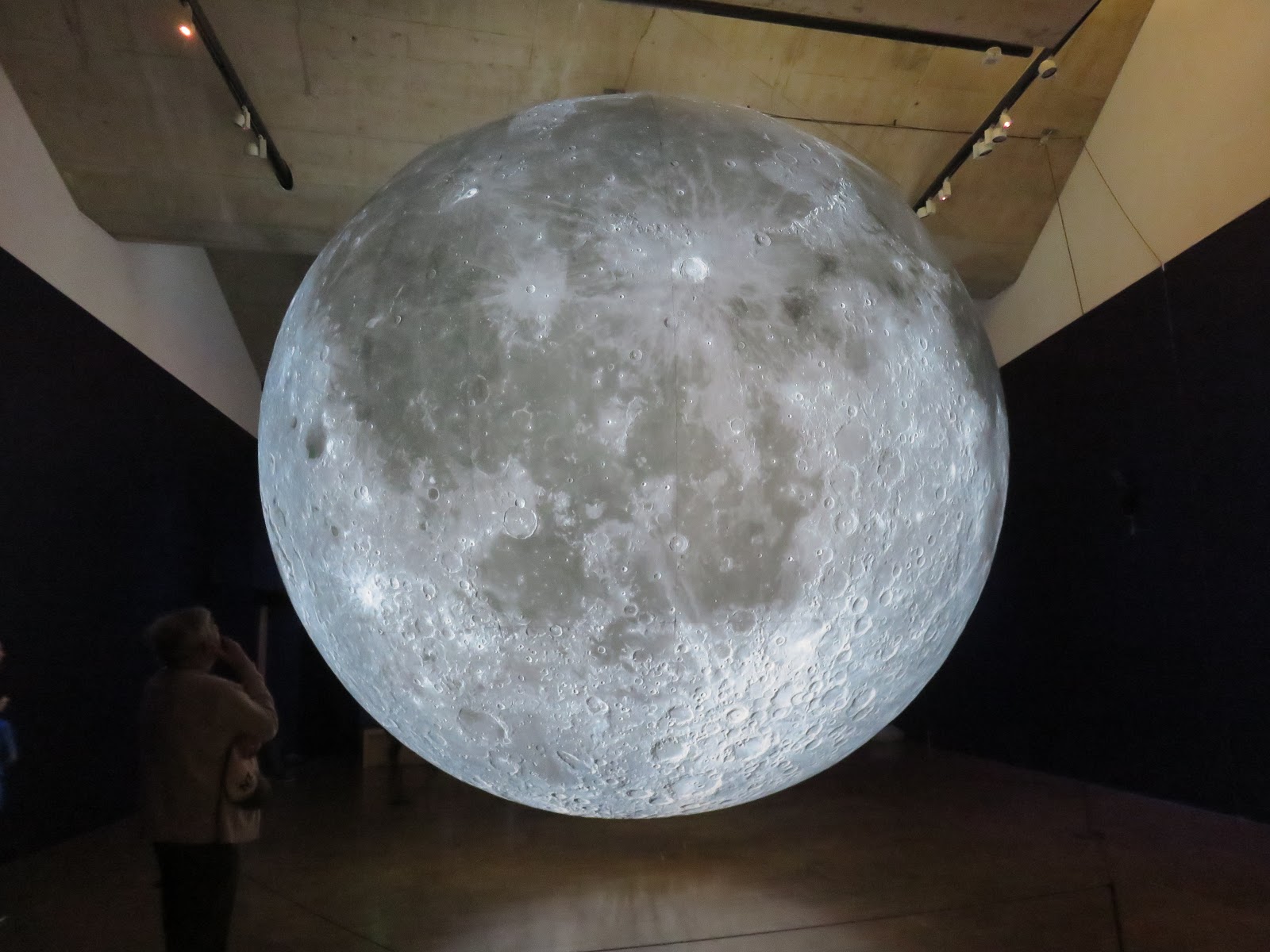
One of the things I wanted to see while we were in Lincolnshire was artist Luke Jerram's  'Museum of the Moon' , which is a  1:500,000 scale representation of the Moon, 7 metres in diameter, made using NASA imagery of the Moon's surface.


photo of the Moon (art installation made of a photo composite of the Moon)
Luke Jerram's 'The Museum of the Moon'
It's rather impressive, although it must be even more so when presented in some of the other venues it has visited, such as Tintern Abbey and Liverpool Cathedral ! But  I was happy to have seen it! 

We also looked around the rest of the museum, which has various Roman and Viking artefacts discovered in the locality, and more up to date exhibits, including a Robot guide , which,  in response to  opinions chosen form its touch-screen, will lead museum visitors to a particular exhibit and provide information about it.


Red anthropomorphic robot with University of Lincoln logo on body
Lindsey the Robot
 After a visit to a second hand bookshop (always a high point for my family!) we the went to Sleaford, where we spent some time visiting a watermill and going for a walk by the river, where we found lots of adorable ducklings. I also spotted a water rat!.

photo of a group of very small brown and yellow ducklings, swimming

We also went to the National Centre for Craft and Design, which was, we found, between exhibitions, but did have a small collection of knitted churches, which were rather appealing.


photograph of a model of a church, crafted from grey wool

The knitted churches are a community project called 'Woolly Spires', which was based on the fact that the building of many of the impressive churches in Lincolnshire was funded by wealthy land owners who make their fortunes wholly or in part by wool, from a local breed, the Lincoln Long Wool. The models were made from that same wool, and are of local churches, and were knitted by groups of people from the respective parishes.

The following day, we went to  Gainsborough, to visit Gainsborough Old Hall, a wonderful survival of a medieval manor house


photograph of brick and half-timbered house

It was built in 1460, and was sold once, in 1596, then remained in the same family until it was given to English Heritage in the 1970s!  

It was visited by Richard III in 1483, and later by Henry VIII, (together with his 5th wife, Katherine Howard), in 1541. It also has connection with the Mayflower pilgrims, as the Hickman family, the second to own the hall, included Puritans and was a base for the Separatists, who went on to become the Mayflower pilgrims. 


Photograph of Great Hall of Gainsborough Old Hall, imposing room with half timbered walls, vaulted wood ceiling and banners hanging from the walls
The Great Hall - Gainsborough Old Hall
The Hall remains largely unchanged, and includes the magnificent Great Hall (where, while we were visiting, there was a school group enjoying dressing up and re-enacting a Tudor Royal visit) . There are also rooms with original panelling,and huge and very impressive kitchens. 

It's a stunning place, and I am surprised it isn't better known.

It was our last touristy outing, but not the last event of stay. 

The cottage we rented was very close to RAF Scampton, which is the home of the Red Arrows. 


While they clearly had some time off over the Easter weekend, they were back again, and rehearsing their performances, for the final 4 days of our break, which meant that we had a front row seat to watch their displays, from the kitchen window of the cottage.!


I imagine that permanent residents may find them rather noisy neighbours, but as visitors, they certianly added to our trip!


photo of vapour trials from the red arrows display team, against a blue sky

Tuesday, 7 May 2019

More Travels in Lincolnshire

On Bank Holiday Monday we took a  trip down memory lane, visiting the village where my mother grew up, and the church there where she and my father were married, which was nice. 

We then went to Gunby Hall, a property now owned by the National Trust, nearby.

The estate was owned by the Massingberd family, and the current house was built in 1700, (Now with a Victorian extension),


Gunby Hall 
It has quite extensive gardens, with orchards and beehives, and a wood with lots of bluebells


Bluebell Wood


Tulips
Inside the house, there was a small exhibit about one of the last of the Massingberds to live there, a successful soldier who was friends with Rudyard Kipling - the exhibition included studies for 'The cat who walked by itself' drawn by Kipling, which was nice.
 ,

After leaving the Hall, we then took a trip to the beach, because really, there are some things that you really have to do on a Bank Holiday Monday. Although in a break with tradition, it was warm and sunny, whereas of course traditionally, a Bank Holiday visit to the seaside includes rain, wind, and mild hypothermia!


It was a good day

Monday, 6 May 2019

Lincoln - Castle and Cathedral

My parents celebrated their 50th wedding anniversary this spring, so we booked a cottage near Lincoln so that the whole family could spend some time together, as they wanted that, rather than a big party. 

We were very lucky with the weather, with Easter weekend being gloriously sunny.

We spent one day in Lincoln itself , where we visited the castle. 


It has a long and varied history. The original castle was one of those put up by William the Conqueror, to make the point that he was, in fact, the conqueror, and intended to stay that way. Later, King Stephen was captured here, and the Castle was  in the midst of battles between those loyal to Richard I, and those to King John, and it now holds one of the remaining copies of Magna Carta, (Which was signed in 1215, and has remained in Lincoln ever since, mostly in the Cathedral but more recently in the Castle) and it also saw action during the Civil War, when it was successfully besieged and over run by Parliamentarian forces in 1644.


More recently, in the 1840s, a 'modern' prison was built within the castle walls, and some of the cells remain, as does the chapel, which followed the 'Separate System', where the priosoners were prevented from seeing or contacting one another, so in the chapel each had an individual box, allowing them to see the vicar, but not one another. 

It's a depressing place. 

Although very little of the original castle buildings remain, other than the gate house, the walls remain, and you can walk round them, and from them, see excellent views across the city, to the cathedral and beyond. 


The  West Front of the cathedral is covered with scaffolding at present, but it is still pretty impressive.

The cathedral was another Norman construction, originally completed in 1092, although subsequent fires and earthquakes in the 1100s resulted in lots of rebuilding. Bishop (later Saint) Hugh of Avalon, oversaw the new cathedral in  1192, and it has remained much the same since, albeit with some changes or decor and addition of lots of stained glass.


There is a wonderful vaulted ceiling, and some glorious stained glass, including some beautiful Rose Windows.


There is also modern glass -  the cathedral is home to chapels for each of the 3 services, with appropriate stained glass in each.
Detail from Air Force window
I was glad to have visited. 

Thursday, 28 February 2019

Edward II - Sam Wanamaker Playhouse

From an Assyrian King to an English one, and from history to drama.. 

After visiting the British Museum, I went to the Sam Wanamaker Playhouse, to see Kit Marlowe's  Edward II. 

It is  famous for being (probably) the earliest play in English featuring a homosexual relationship, and was first performed in 1592. It is, as you might guess from the title, a history play, about King Edward II, who reigned from 1307-1327, and (at least according to the play) was murdered by way of a red hot poker .


In this production, Edward is played by  Tom Stuart, and Gaveston by Beru Tessema.

Edward comes across as a man out of his depth, overshadowed by his late father, insecure, but  ill-advisedly stubborn, even pig-headed, when pushed..  

It is interesting that the focus of the other characters anger against Gaveston is focused less on the fact that he is the King's lover, and more upon Gaveston's  birth (he is not a member of the nobility, and the King's choices to grant him lands and titles offends them ) and the King's extravagance. Indeed, one of the nobles (Mortimer,I think) makes it explicitly clear that the King having favourites, or lovers, isn't in itself the problem.

Sam Wanamaker Playhouse stage
There are very strong performances from Edward and Gaveston,  and I enjoyed the nobles, too.Well worth seeing. Even if you do get your toes trodden on by the occasional actor! 

Monday, 5 November 2018

Chained Library Tour, Wells Cathedral

Although Wells is my home town, and I am familiar with most of the Cathedral, I have never visited the library.


West front of Wells Cathedral
Wells Cathedral, West front

It's not generally open,  but they offer tours, for a very limited number of people, from time to time, and back in about January, I booked the tour taking place this weekend.

Wells is, and has always been a 'secular' cathedral, which (perhaps a little disappointingly) doesn't mean that it is a bastion of secularism, but that it was never part of a monastery, (so it never had its own Scriptorium). However, in 1420 its library was founded, and a dedicated library was built above the East cloister, being completed in the 1450s.   


Photo of Cloister of Wells Cathedral from the cloister garth
The East Cloister, with Library above
It is a little unusual in that the library is still housed in the same space. When it was first constructed, there were only a small number of books, and they would have been kept in locked chests, or on reading benches, like long lecterns. The Cathedral had around 150 books in 1530, when the monasteries were dissolved and Wells, like the other great cathedrals, lost most of its books and other treasures. (Thomas Cromwell was the Lay Dean of Wells at the time, so presumably knew what they had, making it harder for them to withhold anything!)
photo of librayr showing wooden shelves and old leather bound books
The Library, Wells Cathedral

Partly for this reason, the books the Library now holds are almost all printed books, not handwritten manuscripts or illuminated manuscripts.

Over time, the cathedral built up its library, and the current shelving and reading benches were installed between 1661 and 1685. The shelves incorporate metal rods to which the books can be chained. 


two shelves of books,the upper ones shelved spine in, and chained, the lower ones shelves spine out
Chained Books
It was explained to us that books were typically shelved spine in, even where they were not chained, but this is more important for chained books, as the chain is attached to the outer edge and not to the spine, which is a weaker point on the book. The chains were made from steel which was dipped in linseed oil to prevent rust, and each hand made chain has a swivel, which ensures that the chains don't get twisted as the books are taken on and off the shelves. 

Our guide also explained that the books were originally shelves based on when they were donated, and sometimes in accordance with specific requirements of bequests, which means that the older sections of the library are not arranged by subject matter or by any system such as the Dewey system, and in many cases , particularly with the chained books, these are still in the same places on the shelves as they have been for hundreds of years.

We were shown some of the library's oldest and more important books.

Frontispiece of Foxe's Book of Martyrs
A (chained) 1583 edition of Foxe's Book of Martyrs (I had not appreciated that it was common, at the time, to have a copy of the book on display in parish churches,  as part of the Reformation's propaganda against Catholicism. In this edition, we were shown how, on some of the illustrations, the books had been vandalised to scribble out the face of the Pope!


Michael Drayton's 'Poly-Olbion', 1612
Then there was Michael Drayton's 1612 'Poly-Olbion', an epic poem describing the history and geography of Britain, with illustrations (this one showing the Isle of Lundy, in the bottom  left) 
One extraordinary book held is a copy a life of St John of Damascus, printed in 1512. It is remarkable because of the handwritten notes written in red ink in the margins. The book once belonged to Thomas Cranmer, later Archbishop of Canterbury, who was responsible for the creation of the Book of Common Prayer, the use of English in the liturgy of the Church of England, and who was of course later martyred under Queen Mary, and the handwritten notes have been authenticated as being in his handwriting! 


Thomas Cramner's handwritten notes

It's rather endearing to see that even 500 years ago, bored students were colouring in the 'O's and 'Q's in their text books..


Map of Iceland, Ortelius

There was a copy of Ortelius's Theatrum Orbis Terrarum which was originally published in 1570  and seen as the first modern atlas. The Cathedral's copy is the English translation, printed in 1606. The picture shows the map of Iceland, complete with sea monsters  around it, and volcanoes on land.

Pliny's Natural History, 1472 

Something I didn't know was that when printed books first started to be produced, they would sometimes be made to look like the older, hand-scribed books, perhaps so they were still seen as equally valid.  One such is the library's copy of Pliny's Naturalis Historiae, printed in Venice in 1472, with the capital letter and decoration added in by hand to the printed text. The book also has it's own story. The book was lost  during the reformation, and then Dean Ralph Bathurst found   it, in a secondhand bookshop, in 1682, and bought it to return to the cathedral! 

Although the library primarily has printed books, we were also shown one of it's few manuscripts, the Hayles Psalter, commissioned under the will of Sir John Huddleston, for Hayles  Abbey in Gloucestershire. The frontispiece shows the Tudor rose of Henry VIII paired (in the left margin) with the Catherine of Aragon's symbol, the pomegranate, and lilies and carnations for the Virgin Mary. The Psalter is dated 1514, although it did not come to Wells until 1863.


Frontispiece of the Hayles Psalter, 1514
 The library also has on display some documents from its own history, such as minutes form the meeting of the Chapter in 1685, recording Dr Richard Busby's gift to 'Beautify the library' (a gift worth around £2M in today's values)


Chapter Minutes, 1685
I found the visit to the library fascinating, and afterwards spent a little time wandering around the cathedral. I tend to forget, between visits, how beautiful it is.


Scissor Arches and Nave
I am particularly fond of the ceilings, in the nave and the lady chapel, and how full of light the cathedral can be.

Lady Chapel Ceiling
As it is approaching Remembrance Sunday, and this year is the centenary of the armistice,the cathedral has installations remembering those  killed, in WWI in particular. The poppies flowing down the Chapter House stairs were, I thought , especially effective.

Chapter House Stairs
In all, a fascinating morning. And a reminder of how much there is to see on my own doorstep, so to speak!