Showing posts with label Lycian. Show all posts

Sunday, 17 June 2012

In which there are ruins, and hospitality

We had only hired the car for part of our holiday, and after our lazy beach day decided to make the most of it before returning it, by taking another trip to look at more ancient remains.  

Our chosen destination was Sidyma (Dodurga), about an hour’s drive from Fethiye. It was described as being unspoilt, and as none of us had been there before, it seemed like a good idea. It was.  

The village of Dodurga is small, and has grown up around the site of the ancient  Lycian town of Sidyma – indeed, many of the houses have made use of bits of the ancient buildings  (well, with all that handy dressed stone around, why wouldn’t you?) The village is reached by going up a long, narrow, partially un-tarmacked road, and if you are us, you overshoot and drive even further up by mistake, but the views are good so you don’t really mind)

 Once we arrived, we parked next to a rather battered farm truck, and settled down on some bits of ruin under a mulberry tree to eat our picnic before we explored. As soon as we sat down, an older lady came out to great us, and, when we turned down her suggestion that we come to her ‘café’ ( a collection of small tables in her garden, with a handwritten sign advertising hot and cold drinks) she went away, to return a few minutes letter bringing dolma, which she insisted we take, and  were delicious.

A few moments later she came out again, this time with a large jug of ayran, which we turned down as politely as we could, given our very limited Turkish. Ayran is very much an acquired taste, and not something which it’s very easy to drink just to be polite. However, happily she did not appear to be offended, but instead, disappeared again, and returned with çay, which we enjoyed (and she accepted our offer of some of our cherries, in return) 
There was no request for, or suggestion of any payment, it was, it seemed, genuine kindness and hospitality. 

Once we finished eating our lunch and drinking çay, we collected up the plate and glasses to return them. She then invited us into the house. She and her ?mother were interested in where we were from. They did, then, bring out some carved spoons and things, and some scarves, but with no pressure to buy anything! Before we left she gave us all bunches of mint picked from her garden.

After our lunch and çay, we went to look around the site – the path was stony, and some of the stones were obviously pieces of ruins – pillars and so forth – and there were other pieces in the wall.. then we came upon the first bits of  building – a tomb repurposed as a field wall, others standing at random in the centre of fields, or built into a shed.
including a small building, or tomb, with a patterned ceiling still in place.
As we wandered further, we found a whole hill covered with tombs, some of which still had lots of visible carving and inscriptions.
None of it showed any sign of being curated – there were no signs, no fences, just the ruins, among the locals farm (there was one part of the site we didn’t explore, as the ruins were surrounded with ripe, but uncut barley.

 We must have spent an hour or two exploring the site, climbing into a tomb or two, (and getting viciously stabbed by ultra-prickly thistles) it was fascinating. And there wasn’t another soul  in sight for any of the time we spent exploring the place.

 After we left Sidyma, we called in at one final Lycian / Roman site before heading home – this was Pinara, which is up a very steep, rocky road, with vertiginous drops down from the side of the road.

Pinara was very slightly more developed that Sidyma, in that there was a little hut at the entrance, with the inevitable elderly man and his backgammon-buddy to sell us entrance tickets. But as we hadn’t the right change he let all 3 of us in on 2 tickets, rather than try to make change for a large note!

We started by exploring the rock tombs. These were in a cliff, at the base of which there was a stream,  populated by dragonflies on electric blue. Visiting the tombs involved a lot of scrambling around, and in some cases, into, the tombs. It was clear that bits of the cliffs fall down from time to time, but fortunately none of them fell on us.

There was wild thyme and mint and basil, and fig trees, and bougainvillea and hibiscus. Clambering up to the tombs I saw a little yellow snake, and later, as we walked along towards the ruined bathhouse we saw lizards and tortoises and jays, too.
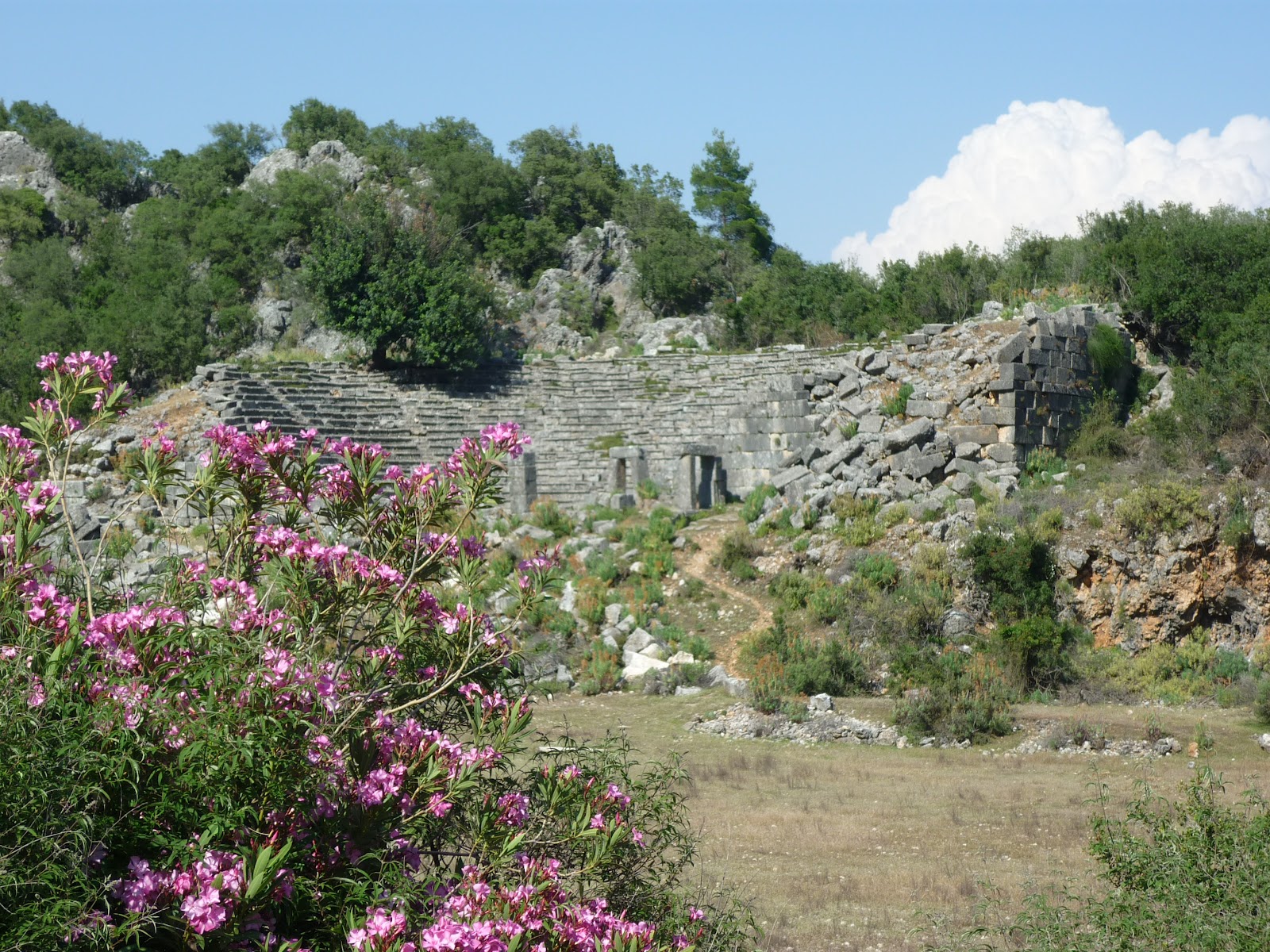
The baths were almost completely ruined, but there was an amphitheatre which was almost complete, and very beautiful.

More photos on flickr

The entire site was huge, and we had it to ourselves. It was fascinating, and peaceful.

Friday, 15 June 2012

Lazy day.

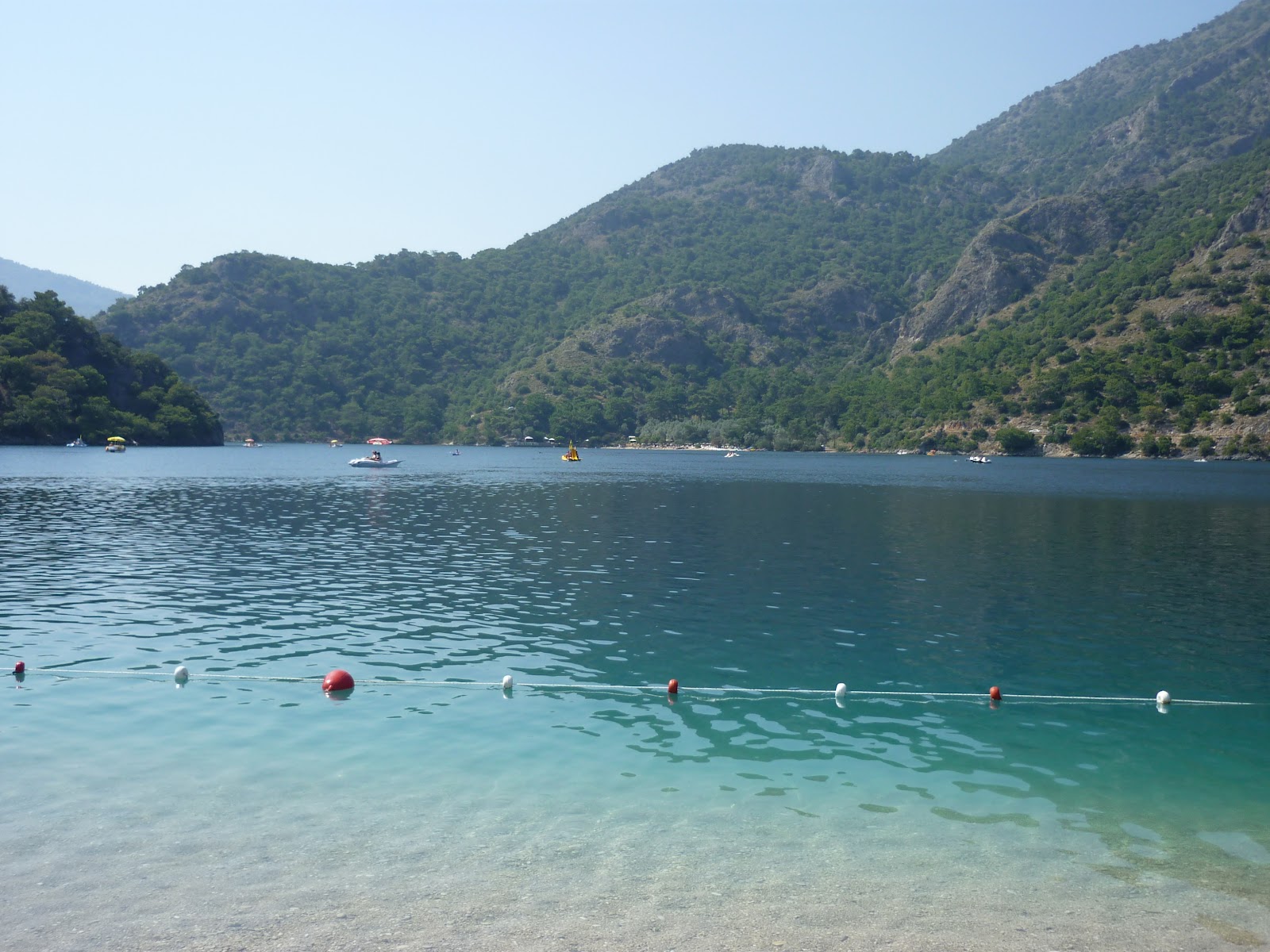
It came as a shocking realisation to us that despite having been in Turkey for 4 days, we had somehow omitted to spend any time sitting on the beach, so on Sunday, after a late and fruit-filled breakfast, we headed out to Ölüdeniz, which is reported to be one of the most photographed beaches in the mediterranean.

It is lovely. There is an almost land-locked lagoon, and it is a National Park (Loggerhead turtles lay their eggs there,so it's protected) - no motor boats are allowed in the lagoon, so it is quiet, as well as beautiful.

It's also very busy. The beach is covered with sunloungers and parasols, all for rent, and there are lots of little booths selling cold drinks, snorkles, ice cream and so forth. It's not the kind of place I normally go, but a little hard lounging once in a while never hurt anyone.

We rented a some loungers, and settled in for some hardcore relaxing. We'd brought along some goggles and snorkles, and I went for a long swim. The water is crystal clear, and there are lots of fish, even in the shallow water by the beach. Around the rocky banks at the end of the lagoon, where it was quieter, there were not only fish (in every size, from whitebait up to 2-foot long thin, pointy fish with blue and yellow bits on) teeny tiny jellyfish, a few sea-urchins, even sponges. If, like me, your normal sea-side experience involves the North Sea or English Channel, then the mere concept of being able to swim for more than 10 minutes without losing all feeling in your extremities and turning an unattractive shade of blue is, in itself, a revelation. Doing it in water so clear, and being able to see so much, is even more amazing.

We stayed until almost all the sun-loungers were empty, and the shadows growing long. sometimes it's nice not  to have a time table to keep to.

We dined that night up at the kale Park restaurant, which is at the top of the hill above Fethiye, with views out over the town, and the bay.

The retaurant is next to the ruins of a crusader castle, and there was, inevitably, a small selection of goats scrambling among the ruined walls!

We sat over our meal on the terrace all evening, watching night fall, and the stars come out.

And one of my favourite things about this town? The random Lycian sarcophagus in the middle of the road...

Monday, 11 June 2012

In which there are more ruins

After leaving Patara, we decided to call in on some more ruins on our way home, and decided to go to Letoon, which apparently has a mosaic and some nice bits of temple.
It took as a little while to find it, as we were lulled into a false sense of security by the fact that there was a sign post on the main road, which led us to believe there would be signs at the next junction, too.
This turned out not to be the case, but fortunately there were not very many junctions. The area is an agricultural one, and there were lots of big greenhouses full of tomatoes (we suspect that the greenhouses are more about preserving humidity than heat) and little fields with goats, and the occasional old lady cutting hay with a scythe. We found ourselves back at the main road, did a u-turn under the bemused eyes of a elderly gentleman and his 7 goats, and shortly after that, as we went along the road we hadn't previously tried, we turned a corner and came upon an amphitheatre, so we deduced we had arrived.
Letoon Amphitheatre
The caretaker seemed somewhat surprised to have visitors, but he happily interrupted his game of backgammon to sell us entry tickets, and then we were free to wander around by ourselves. The place is named after it's temple to Leto (who, as I am sure you know, was the mother of Artemis and Apollo) It was primarily a religious, rather than residential area, and had temples to Leto, Artemis and Apollo. The temples to Apollo and Artemis have been destroyed, but the temple of Leto, remains, and several pillars have been re-erected.

There are olive trees among the ruins, sheep grazing in the amphitheatre, and frogs in the water. And tortoises, although they are not very friendly!
amphitheatre with sheep
There were no other visitors, and we enjoyed wandering around in our own time.

And then, because we were, after all, on holiday, we went home, and then out to a wonderful fish restaurant. We didn't bother with a menu, we just ordered meze, and they bring out delicious little dishes until you tell them to stop.

I can't remember all of them, but we started with samphire, and later there was calamari with spices, stuffed mushrooms, hunter rolls (like spring rolls, but stuffed with cheese and prawns) curried baby octopi... I seem to recall a bottle of wine, too.

It was a good day.

Sunday, 10 June 2012

In which there are trains and planes and sisters and sunshine

I've been away from the internet for the past 10 days or so, as I've been away on holiday in Turkey with my sisters, and for part of the time, with D, my sister K's soon-to-be sister-in-law.
We had a great time, and I really enjoyed being able to spend time with my sisters, and getting to know D.

I think it will take more than one post to cover it, so will take me a few days, but here goes!

Our flight out was on Tuesday evening, from Gatwick, so my younger sister E drove to mine for lunch, then we went to K's home where we left E's car and all 3 of us got a trian to Gatwick.

As we were going on holiday, I'd come prepared, and once we were safely on the train produced cans of G'n'T, slices of lime, and ice cubes (it's harder to transport ice cubes secretly and with no cool bag than you might think) so we all had drinks in style.

We then met D at Gatwick, and spent 4 hours on a charter flight filled with fractious children! Once we got to Dalaman, however, things improved - we picked up out hire car, and K bravely drove us home, in the dark (Both Turkish roads, and Turkish driving, tend to be.... interesting!

K's fiance owns a flat in Fethiye, which is where we stayed. It's about 25 mins walk from the centre of the town, slightly up on the hill, so it's a little cooler, which is nice.

We spent our first morning stocking up on food, then, as one does, we headed out to the Hamman (Turkish Bath). We decided, on the advice of some of K&C's friends, who had visited just before us, to try a new hamman at one of the local hotels - it was very modern and shiny - and instead of the traditional cold shower after the sauna and scrubbing there was a very cold plunge pool, instead. It was fun, and very relaxing,but all of us who'd been hamman-ed before agreed that we preferred the less slick sand more traditional city hamman, and resolved to go there for our next scrub! Although the hamman proved, once again, that no matter how well you believe you've exfoliated, the Tellak (masseur) will prove you wrong. I do wish that there was a Turkish Bath near me at home!

The following day we decided that some Proper Culture was appropriate, so we drove to Patara, which is a Lycian site - it was an important naval base around the time of Alexander the Great, was mentioned in the Iliad, was visited by emperors Hadrian and Vespasian and was the birthplace of Nicholas, Bishop of Myra (AKA Santa Claus).  It was eventually abandoned after the harbour silted up, any many of the ruins were hidden, and preserved, by the sand dunes.


Parliament Building, Patara
There has been a lot of archaeological work going on over the last 20 years or so, including, most recently, the excavation and partial reconstruction of the Parliament Buildings - there were the headquarters of the Lycian league, and the archaeologists have partially rebuilt it using some original and some replacement material, and leaving parts as they were found, so that in the seating, for instance, you can see the original ruin, how the building was constructed, and finally the finished article, faced with marble etc.
Patara amphitheatre
There is also an amphitheatre, which has not been rebuilt, 2 bathhouses (one of which is currently propped up with a good deal of scaffolding,

Harbour Baths, Patara
And the triple-arched 'Arch of Modestus' (who I can't help feeling may have been misnamed) and, of course, several of the pointy topped Lycian sarcophagi which I have come to associate with this part of Turkey (there is one in the post office garden, in Fethiye, for example..)

Lycian sarcophagus and arch of Modestus, Patara


 Oh, and did I mention that as well as these spectacular classical ruins, Patara just happens to have a rather nice beach?


I have to admit, that being able to swim and sunbathe on a beautiful white beach in between sessions of exploring ancient Greek/roman and Byzantium ruins does add something to the experience!


After leaving Patara, we went on to Letoon, but that will have to wait until a later blog, as I need to sleep, now.