Showing posts with label Interesting Stuff. Show all posts

Wednesday, 21 November 2018

I object - Ian Hislop's search for dissent

As I was planning a trip to London, I decided to go up slightly early and visit the exhibition at the British Museum, I Object - Ian Hislop's Search for Dissent. (I have every Intention of seeing their Ashurbanipal exhibit, but I'd booked this in advance, and did not have time for both in one day) 
The Great Court of the British Museum,  

 I always enjoy visiting the museum, especially the Great Court, which looked particularly lovely due to the blue sky and sunshine.

The exhibition itself (held in the reading room) is small, and it's a personal selection made by Hislop.  As such, it's perhaps not as structured as some exhibitions, but it is nevertheless interesting.


There are some very early exhibits. For instance, graffiti and frivolous paintings from ancient Egypt, 
Ancient Egyptian painting


There are some survivors of dissent, such as this  head of Christ, created in around 1130, which survived the Reformation and destruction of idols, as it was buried in the church, at some time during the 16th Century.

12th C. Head of Christ
There were, perhaps inevitably, lots of political cartoons, and commentary. This 'bank note' was created by the caricaturist, George Cruikshank, in 1819, after witnessing 2 people hanged for  forging bank notes. 


There were plenty of more modern items, too, from a 'pussy hat' ,  'war rugs' (woven in Afghanistan in the 1970s and 80s, incorporating patterns of soviet tanks and helicopters in the place of traditional motifs or images of mythical creatures),  to a pair of carved wooden gates, from Nigeria, carved by Yoruba people using traditional styles and images, but incorporating mockery of the British Colonial rulers of their country (something which was, apparently, not noticed by the rulers, as the gates were displayed at the 1924 British Empire Exhibition.

There was a copy of the notorious 1616 'Wicked' Bible, in which a crucial 'not' is missed out from the 7th commandment, meaning that God is cited as telling Moses 'Thou shalt commit adultery'


The error is generally put down to a typesetting error, but in his note to the exhibit, Hislop speculates that it was perhaps a deliberate act of sabotage by a disgruntled  typesetter or rival printer.


And finally, there is the hoax perpetuated against the museum itself, in 25, when the artist, Banksy, added his art (with accompanying label ) to a wall in the museum, where it went un-noticed for several days.

It's an interesting way to spend some time.

Sunday, 4 November 2018

Anglo-Saxon Kingdoms: Art, Word, War at the British Library


Before I went home after the Dresden Dolls gig, I went to the British Library to visit their new exhibition, Anglo-Saxon Kingdoms: Art, Word, War.

It was a little frustrating, as they have clearly underestimated the time people would need, and how many people can see the exhibition at any one time, so despite going on a Wednesday  morning when it was not fully booked, it was very overcrowded ,so visiting was rather like being in an (admittedly very educational)  queue.

However, despite that irritation, the exhibition is very impressive.

It has a broadly chronological approach, beginning with the Loveden Hill Urn, which dates from the 5th Century, which has a runic inscription being  one of the earliest pieces of evidence of the English language.

Also on display, Bede's Ecclesiastical History of the English People (731AD), a 12th image of Woden, the Lindesfarne Gospels, The Codex Amiatinus, which is apparently the oldest surviving complete Latin bible, and which was made in Jarrow, in the early 700s. It was sent to the Pope, in 716, and this is the first time it has returned to England since then.

The Book of Durrow has been borrowed from Dublin, and the Echternach Gospels from Paris.

Although many of the books on display are religious in nature, not all are. There is a very early copy of Beowulf, the Vercelli Book, a 10th C collection of poems , the Anglo Saxon Chronicle, and a number of land grants and wills, including some given by Offa, some by King Alfred, (and the library has also managed to borrow the Alfred Jewel from the Ashmolean Museum, to go with the manuscripts)

They had also borrowed some items from the Sutton Hoo burial, and the Winfarthing Pendent.
 
The Winfarthing Pendent

But the majority of what is on display, are manuscripts. And they are glorious. It says something about the quality of the exhibition that when you reach the end, and find that one of the final items on display is Domesday Book, it comes almost as an anticlimax! 

It is fascinating, and I would have loved to have had the chance to look around with more time and fewer people! 

The exhibition is on until February, so plenty of time to visit.


Wednesday, 1 November 2017

Scythians - British Museum Exhibition

I have to admit, that before the British Museum started to advertise their exhibition about the Scythians, I knew next to nothing about them.For these who are similarly uninformed, 'Scythians' seems to be a blanket terms for the various tribes of nomadic peoples, or Iranian origin,  who lived in and around what is now Siberia, around 2,500 years ago. 


They didn't leave any writings, and until comparatively recently, were known mainly from the writings of Herodotus (who was often somewhat unreliable). They are, apparently, the likely inspiration for ancient legends about the Amazons, and possibly also for legends about centaurs, as they were among the wolds earliest horseback warriors.

More recently (for 'recently, read, starting in the reign of Peter the Great, 1682-1725) archaeological finds began to emerge, including amazing gold artefacts and, due to the permafrost, burials in which wood, leather, textiles, bodies and other organic matter were preserved, astonishingly well preserved. And it turns out that Herodotus may have been rather less unreliable than we thought.


Deer-shaped gold plaque. Second half of the 7th century BC.
© The State Hermitage Museum, St Petersburg, 2017. Photo: V Terebenin.
The exhibition includes a lot of beautiful gold artefacts - many featuring animals from big cats wolves, boar and eagles, to deer, elk and of course horses. However, there are also other artefacts - clothing, human remains, textiles and wood, all of which have been preserved by the ice. 


Felt swan figure, third century BC.
© State Hermitage Museum, St Petersburg
It's astonishing to think this swan, for instance, is over 2,000 years old. And its a very appealing swan.

As well as the more showy gold and textiles, there are other gems - the felt bag containing cheese, (sadly, the museum has been unable to determine whether this was made from sheep, goat or horses milk), the hemp-smoking kit, and the coriander seeds...

The exhibition also includes some human remains; there is one display showing a man's skin, and his tattoos, and there are also two skulls, with their death-masks.

There are personal items too - a woman's felt stockings, a child's jacket, a flat-pack table, and a false beard. And the lack of written records leave intriguing questions - was the beard due to funeral rituals (apparently contemporary sources describe the Scythians as generally having beards, but the men in burials found are all clean shaven), was it perhaps related to the fact that women may have been warriors too. Maybe they simply enjoyed dressing up!


The Scythians were very reliant on their horses, so there are also lots of horse-related items - beautifully decorated saddles and bridles, and even head-dresses for horses, decorated with other birds and animals.

It was very interesting, and some of the things on display were incredibly beautiful.


Also - have a gratuitous picture of the Great Court at the museum. Just because I love that roof. 

The exhibition continues until 14th January, so plenty of time to see it, if you haven't already done so. 

Sunday, 8 November 2015

S.P.Q.R

I'm very lucky to live close to Bath, which has two lovely independent bookshops, Mr B's and Topping and Co Books, both of which regularly arrange events and signings.

One of the most recent was an event organized by Toppings, featuring Professor Mary Beard, who was in Bath to talk about her new book, S.P.Q.R.


Prof. Beard is a very interesting speaker: she spoke about how questions may be raised about whether there is a need for more books about the Romans, and a lot of what she spoke about were the new developments in archaeology which have produced new information and new insights into the past, but also made the point that historians in each age ask different questions, so of course what they discover, and how they interpret information, varies.

One example she gave was that in the past, (male) historians have tended to assume that Roman barracks were very masculine spaces , but the number of children's shoes


Beard spoke about a number of recent developments and discoveries which have provided new information, for instance:

 - Analysis of ice core samples from Greenland which show signs of pollutions from Roman mining operation in Spain

- Analysis of teeth from Roman burials which show the climate (and therefore, to an extent) the region, in which people spent their childhood (or at least that part of it during the period their 2nd teeth were growing in). This has been particularly interesting in looking at the teeth of Roman Britons. It seems that around 20% of the Roman population grew up in significantly warmer climates,which suggests a much greater degree of movement within the Roman world than previously thought.

- Analysis of the material found in cess-pits in Herculaneum, which gives information about the diet of ordinary people, whereas in the past, the main evidence has been from Roman writing, where descriptions of food have tended to be about the banquets of the rich, not about normal, every day food. The new evidence shows that ordinary people in Herculaneum were eating a lot of fish, chicken, eggs, figs, sea-urchins, pork, and pepper (which would have been imported, and presumably, expensive)

As well as new scientific evidence, she explained the there are also, still, new literary discoveries to be made - around 10 years ago a new essay of Galen's was discovered in the library of a monastery in Greece.

She explained that she Chose S.P.Q.R. as title as she wanted to include and focus on the 'Populi' - the people of Rome, not just the senate or aristocracy - and in particular to think about women and their role.

I would like to read the book, but admit that I shall wait until it comes out in paperback - the hardback is vast and heavy! But I may be re-reading her book about Pompeii in the mean time! 

Tuesday, 1 September 2015

A Trip to Dismaland

I don't live all that far from Weston-Super-Mare, although I very rarely visit, but when I saw that Banksy (and others) had created a pop-up amusement park there, I thought it was worth a visit.

Tickets are not easy to get.. either you go to Weston and queue for hours, and maybe you get in and maybe you don't, or you try to catch the website in one of the brief moments when tickets are on sale and available, and pre-book. 

Which was what I managed to do. So on Sunday, I set off on my way to Weston. 

It started to rain as I left the house, which seemed appropriate, and as I got closer to Weston I found myself feeling more nervous, which I rather think is due to the fact the only reason I ever used to go to Weston was for driving lessons, and to take my test (we had to go to Weston as we didn't have any roundabouts or dual carriage ways nearer home). 

However, on this occasion, no-one made me do an emergency stop, or a three point turn, although I did have to do some reverse parking on a bit of wasteland which had been co-opted by the council as a spare car park.

It was still pretty grey and grim when I arrived in Weston, (to be fair, it's pretty grim even in glorious sunshine. . it is a town which would like to grow up to be Blackpool, but can't quite make it.. It is a perfect venue for a subversive theme park.

It starts with a queue (even if you have pre-booked), but I had brought a book for that. Then once you get through the queue there is an airport-style security checkpoint, with meticulously hand-crafted cardboard surveillance cameras and x-ray machines, and convincingly grumpy 'police' who randomly take people aside to search, and to question for offences such as smiling or looking cheerful (while telling other attendees to 'move on, nothing to see')  Accompanied by nervous laughter from those selected. . .

Once inside, things get even more interesting.


Stallion : Ben Long
There is a magical castle (a little battered, of course) and some amazing, gigantic sculptures, including the Stallion made entirely from scaffolding, which I loved, and a pair of articulated tanker lorries which were either dancing or mating...
Big Rig Jig : Mike Ross
There are sideshows - where you can try to win an anvil at an anvil-shy (like a coconut-shy, but with anvils..) or try to catch plastic duckies (dead ones, from a pool with an oil-soaked pelican in the centre, of course) 
There is a ferris wheel, and one can play mini-gulf  (like mini-golf, but with added oil-based war)

There is also a merry-go-round, which is almost normal, (and available for the children to ride on)  until you look closely, and realise that there is already one passenger on the roundabout...


And then there is extra art. There is a pickled unicorn, by Damien Hirst, some of the most disturbing crockery you are ever likely to see, by Ronit Baranga, not to mention some trophy heads which are a worrying mash-up of wedding cake, false teeth and great, curving horns..


In a another gallery there is more art, including an embroidered car, a mushroom-cloud of a tree house (or perhaps a tree-house of a mushroom cloud), by Deitrich Wegner, and a perfect, macabre fairground horse.


It is here, too, that one of Banky's own pieces (Mickey Mouse engulfed by a snake) is to be found,  along with lots of other art, some amusing, some disturbing, almost all thought-provoking. (I enjoyed Kate Macdowell's box of mice (each with it's own human ear), and Jessica Harrison's china tattooed ladies.


Did I mention Death?  He is there, too, spinning around on the dodgems, to a raucous rendition of 'Staying Alive'.

There is a lot more, too. It's all weirdly fascinating, often depressing, in places thought-provoking and in others surprisingly funny. 


And the determinedly grim and grumpy staff are a constant reminder of how any sane person would be, if working in an amusement park and not contractually required to smile...!


I had reservations about going, and I nearly decides against it when I saw the queue, but I am glad I persevered.

 (more photos on Flickr if you are interested)

Oh, and then after leaving Dismaland, by way of contrast I visited the Sand Sculpture festival, which was not seeking to be subversive or controversial at all. It was weird.

Monday, 4 May 2015

What I Did on My Holidays: Cluny

Day two of our trip started with a visit to theMusée national du Moyen Âge (which used to be known as the Musee de Cluny). 

The museum is housed in the former Benedictine Abbey of Cluny, near the Sorbonne, in very attractive buildings.

It is famous for housing the 'Lady and the Unicorn' series of medieval tapestries, but also has a huge collection of other artifacts.

Swabian wood carving
When we visited, the museum was holding an exhibition of Swabian wood carvings. 

These were impressive by virtue of their age and state of preservation, but I have to admit that they did not appeal to me very much aesthetically - it is extraordinary that they have survived since the 1500's.

Stained glass - Partridge
The Abbey was built on the site of a Roman Bath-house, parts of which remain,  and the museum also has a number of pieces of Roman carving (mainly the heads and bases of various columns) as well as later additions such as statues from various churches around Paris. (Apparently a lot were removed as they were seen as Royalist, during the revolution)

Ivory Casket - 1300
There is some stained glass (I enjoyed the Partridges), and other art work, including reliquaries, a few illuminated manuscripts and some works in ivory. 

I particularly liked an intricately carved ivory box from around 1300, illustrated with scenes of knights and ladies, and courtly love.

And a gold rose, which is delicate and perfectly formed. 

Then there are the tapestries themselves.

The 'Lady and the Unicorn' series consists of 6 linked tapestries, 5 of which illustrate the five senses, and the 6th, "À mon seul désir"  which has been interpreted in a number of ways, including as love, free will, or even renunciation of the emotions or passions raised by the first 5 senses.

Taste
The tapestries are large, and all show the arms of the Le Visite family. They have been dated to the end of the 15th or beginning of the 16th Century, and are charming.
"À mon seul désir"


As well as the Lady, and the Lion and Unicorn, the tapestries all have lots of other birds and animals in the background 

Mostly rabbits, but there were also hawks, storks, foxes and a  magpie. 

There was also something which the guide said was a baby unicorn, although how they decided it wasn't just an ordinary foal (it had no horn) they did not disclose.

I have a particular weakness for the rabbits, although there was also a rather nice stork or heron, lying on it's back in order to fit among the flowers!

The 'Lady and Unicorn' tapestries are not the only ones, there are also a whole series of 23 tapestries detailing the life of  St. Stephen, completed in 1490. (There is a scene where his body is exposed to the beasts, which features a rather lovely porcupine).

There are others showing daily life, including one of a woman spinning using a drop spindle, which includes a cat playing with the thread - obviously cats have changed very little since the 1500s!

There is also the Abbot's chapel, which is small, but exquisite.

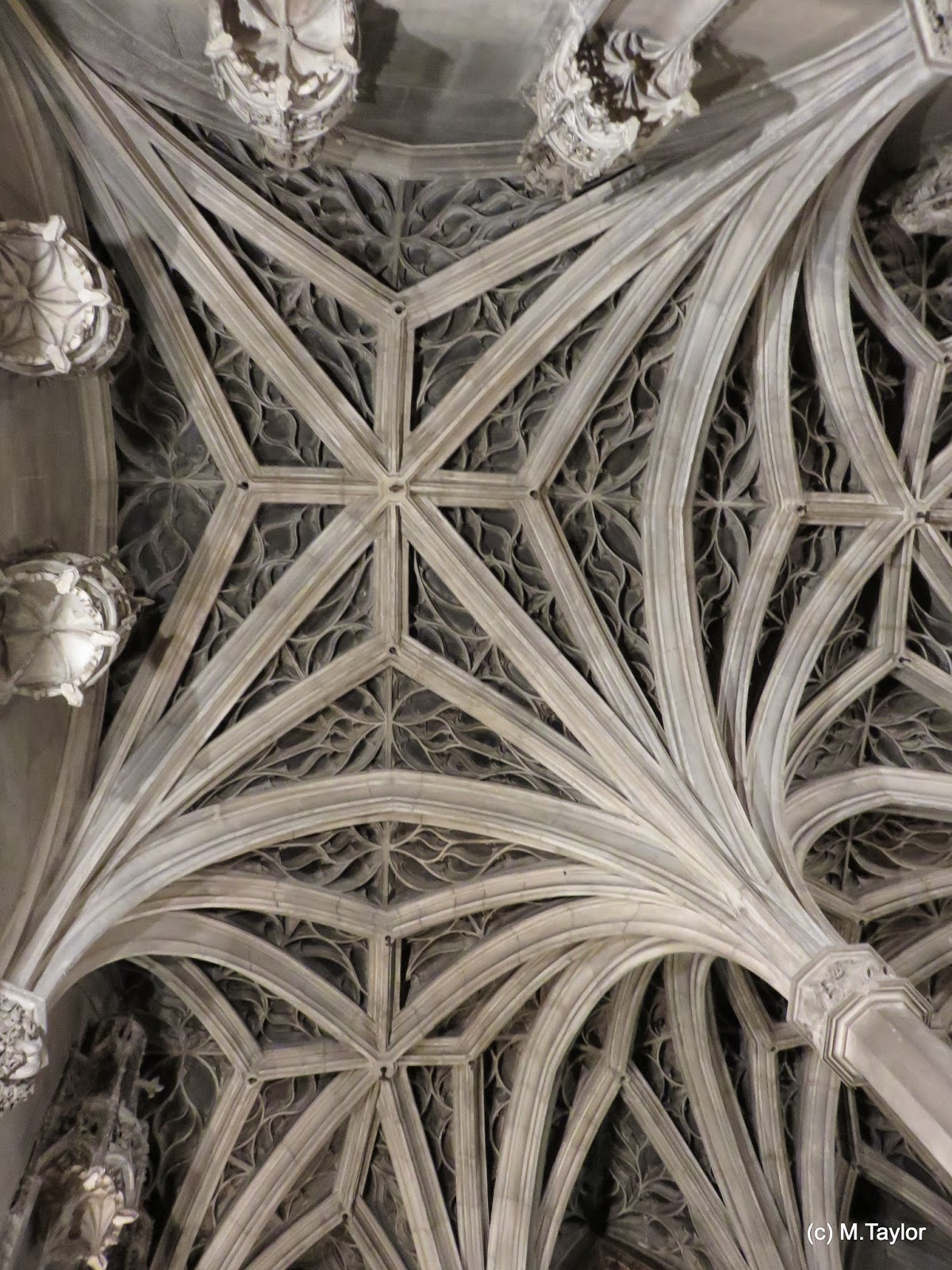
I loved the delicacy of the stone carving in the ceiling.

It is not a museum I am familiar with - this was my first visit, but it is well worth it. We spent most of the morning there, and it would not have been difficult to stay longer. We mostly only left because we got hungry! 

Saturday, 17 May 2014

Vikings

Once I had the tickets for the BL event for Friday evening, I also booked for the Vikings exhibition at the British Museum, so spent some time there before meeting up with my friend, to head on to the Library. 
Roskilde 6

I was a little disappointed at the exhibition. Firstly,  the exhibition has timed tickets and limited availability, but they seem to have seriously misjudged how many people can realistically see the exhibits at any one time, with the result that it was massively overcrowded. Given that the majority of exhibits are small and intricate, this is a particular disadvantage! 

The stand-out exhibit, and the exception to this, of course, is 'Roskilde 6' the remains of a 37m long Viking ship.The ship has been dated to around 1025 AD (around 20% of the display is the original timbers) It is dramatic and awe inspiring, but the rest of the exhibition does not entirely live up to it!

That said, there are interesting exhibits - some beautifully ornamented metal work and stone carving, and lots of fascinating nuggets of information : images and grave-goods associated with sorceresses included their staffs, which in turn had decorative heads reminiscent of spindles/distaffs; the information accompanying them suggested that there were close associations between woman, magic and spinning (So it is not only the Norns who combine magic and spinning!)  There was also a fascinating map of the British Isles, showing the distribution both of placenames of Viking origin, but also of Viking DNA.

I'm glad I saw the exhibit, but do feel that the curators missed opportunities to make it more human - it seemed, for the most part, a little dry and academic, and, as I mentioned, very, very overcrowded. 

And of course, after leaving, I still had the most exciting part of the day still to come!

Monday, 15 April 2013

Very Old Things

Some time ago,I booked tickets for two of the British Museum's headline exhibitions for this year: - Ice Age art and Life and Death in Pompeii and Herculaneum, so Saturday morning saw me on a train to London, to visit the BM and see them both.

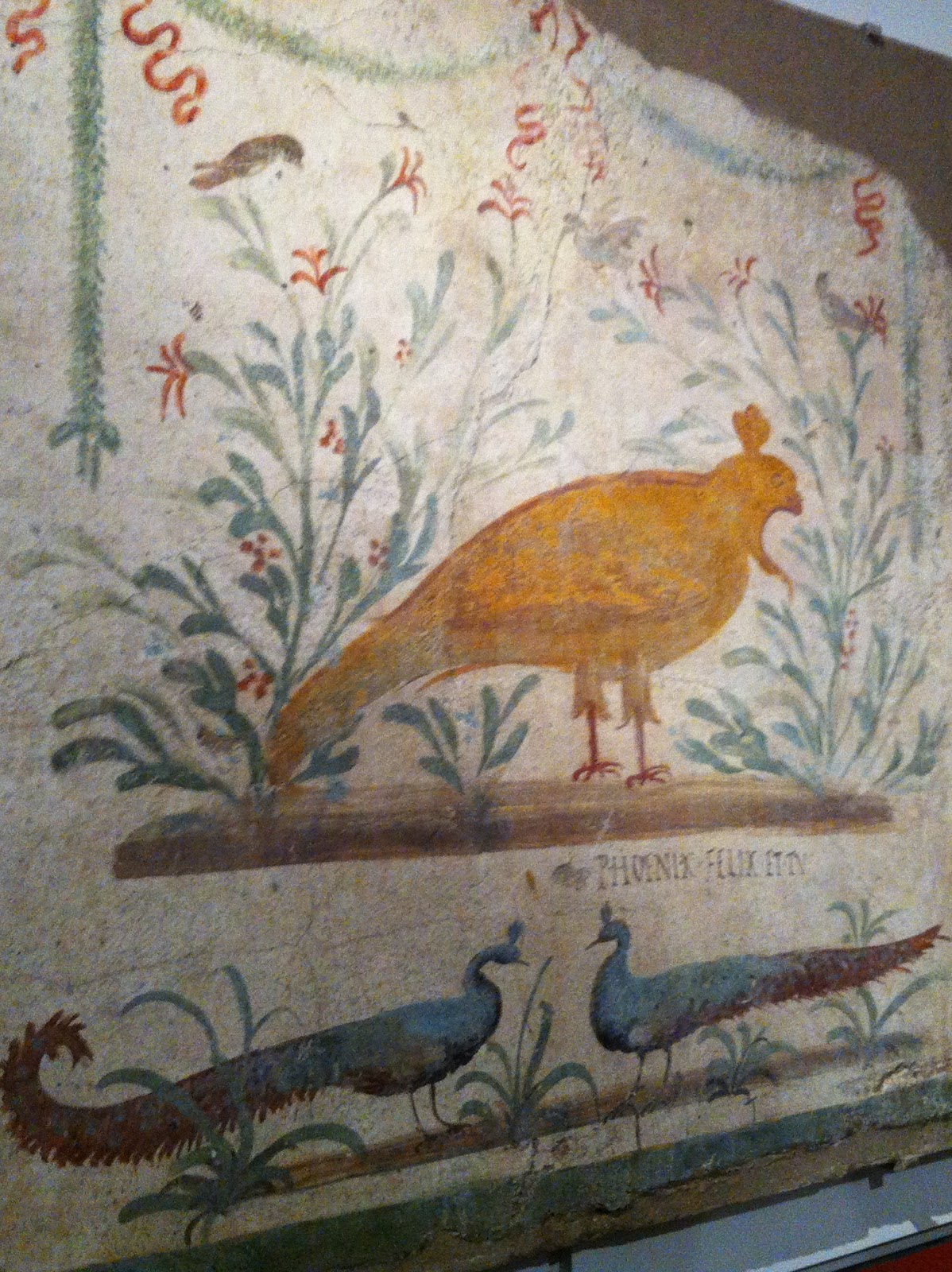
Phoenix
I started with Pompeii. Well, to be truthful, I started with a very nice lunch at a lovely little French bistro not far from the Museum, but after that I went into the Pompeii and Herculaneum exhibition.

I was lucky enough to able able to visit both cities, about 18 months ago, together with the Archaeological museum in Naples, so I was not sure whether there would be many things I hadn't already seen (although of course I had no problem with seeing them again!)

Kitchen Mural
The exhibition is arranged by rooms, a little as if looking around a Roman house -  starting with the street, and moving in to an Atrium, Bedroom, Kitchen, Garden and so forth.

Many of the items were familiar - the 'Cave Canem' mosaic, for example, and the portrait of the Baker, Terentius Neo, and his wife, (which is the headline poster for the exhibition), others were less familiar.

 I don't remember seeing the more technical exhibits, such as pipes and valves which looked startlingly modern, or the fountain head in the shape of a rabbit, before.

There were also various pieces of furniture which I had not seen before - the poignant carbonised cradle, for instance (I'd seen it in TV documentaries, but not in person), a small household alter, and personal items found with some of the bodies, such as a surgeon's implements, a child's charm-bracelet and a key.

There were also items such as loaves of bread, dishes of figs, pomegranates and grain, all carbonised, and therefore preserved for over 2,000 years, which are just astonishing!

Garden fresco
One of the most dramatic and memorable parts of the exhibition, however, has to be the Garden frescos - 3 walls of gardens, with gorgeous and life-like plants and birds.

The exhibition does include a small number of the famous casts - one of a guard dog, and others of a family of four - parents and two young children, but the exhibition focuses on life rather than death. It's very interesting, and I'm glad I went.

(There are more pictures in the Evening Standard's review, here, and on the Museum's own website)

After this, I wandered upstairs to visit Noggin the Nog   the Lewis Chessmen, and a few other bits and pieces, while I waited for the time-slot for my entry into the Ice Age exhibition.

One of the things I like about the British Museum is how big it is, and how much stuff there is, so if (like me) you have a poor sense of direction, you tend to wander down a corridor, or turn a corner, and stumble upon the Mespotomanian Queen of the Night, or a glazed brick guardsman from the palace of Darius of Persia (both of which I saw in between Pompeii and the Ice Age..)

20,000 year old Bison sculpture
The Ice age exhibition was, to me, a little bit of a disappointment - they sell timed tickets, but seemed to have been greedy and overestimated how many people could reasonable view the (mainly small) at once. The exhibition itself is also fairly small. The curators have added some modern pieces, such as Matisse sketches and a Henry Moore sculpture, to highlight how close the relationships between modern and ancient art were.

Despite my grouching, there were some lovely pieces - a beautiful bison, and a lovely horse. And the swimming reindeer, which is part of the permanent collection, and one of my favourites.

It's fascinating to see the skill and accuracy of the sculptures, and to realise that they were created with nothing but bone and stone tools!

An interesting day. Long, but I'm glad had the chance to see both exhibitions.

(Edited to add. The British Museum has created an app to allow you to visit the exhibition vitually, if you can't visit in person.)

Sunday, 25 November 2012

In Which there is Bronze and Regicide

I spent Saturday in London, enjoying a trip to the Royal Academy, to see their Bronze Exhibition, and then to Hampstead theatre to see '55 Days'

I has a slightly stressful start to the day, as the first of my two trains turned out, when I got to the station, to be running late, which seemed likely to cause me to miss my connection, but as it turned out, we made up a bot of time getting to Bath, the London train was slightly delayed too, so with a bit of running, I managed to catch the train, and even to find my seat (not an easy task, as the train was very crowded due to an earlier cancellation), so made it to London as originally planned.

The exhibition at the RA was fascinating. The curators have chosen to group the bronzes by theme, rather than chronologically or by region, so in the section devoted to 'figures' were examples of ancient Greek and Etruscan figures,(including the first piece in the exhibition, a glorious and beautiful 'dancing satyr', around 3,500 years old, found quite recently near Sciliy)
'Dancing Satyr' 


Also medieval saints, works by Ghiberti and Cellini,  images of the Buddha and figures from Benin.

Similarly, in the section devoted to 'Animals' there was a glorious Etruscan Chimera (from around 400BCE), as well as a Louise Bourgoise spider, a Baboon made by Picasso, an Elephant from China, and many others.
Chimera

There were also sections titled 'groups' which included a Frderic Remington group of 4 cowboys on horseback, and also one of the most extraordinary pieces, the Trundholm 'Chariot of the Sun' which is beautiful in it's own right, as well as awe-inspiring for it's age and fragility (It's believed to have been made between 1,800 and 1,600 BCE
Trundholm Chariot of the Sun
I am so glad I managed to get to the exhibition - I know the RA managed to borrow pieces from all over the world for it (although Florence appears to have been particularly generous!)
'Damned Soul' Massimiliano Soldani-Benzi, after Bernini
And of course, the 'poster boy', Soldani-Benzi's 'Damned Soul', which I feel sure must have inspired the 'weeping angels' (I felt safe visiting, there were so many people looking at it at all times...)


After visiting the exhibition, I headed across to the theatre, where, after a brief and welcome break for a sandwich (at one of the least stable tables I've encountered for some time)
I had booked my ticket because I wanted to see Mark Gatiss, and because I thought the play (which deals with the period leading up to the conviction and execution of Charles I, at the end of the English Civil War). I hadn't been the the Hampstead Theatre before, and had not realised that the play is by Howard Brenton, who also wrote 'Anne Boleyn, (which I saw earlier this year, and blogged about here)
Mark Gatiss as Charles I
It's a small theatre, with a central stage with entrances at both ends, which means that a lot of the time the actors don't face the audience - but once I got used to it I rather liked it - it makes you feel more engaged in what's going on on stage.

The play switches between the two main protagonists - Mark Gatiss's Charles I, arrogantly and utterly convinced of his own divine right to rule, and Douglas Henshall's Oliver Cromwell, equally sure of himself (perhaps with better reason) and, despite his talk of 'waiting on Providence', coming across as a far more canny politician.

Charles was presented in period costume, but all of the other characters were presented in (fairly) modern dress - with a 50s feel to it. Despite knowing the inevitable outcome the play still managed to be gripping, as the parliamentarians struggles with the issues of whether to put the King on trial, and if so, whether he should be executed, not to mention whether and how Parliament could try him, and whether the ends (putting him on trial) justified the means (Pride's Purge of Parliament, which effectively rigged the vote by ensuring that anyone who voted against the trail, first time round, being excluded from the second one...)

The performance I saw was the last but one of the run, so I can't advise you to grab tivkets and see it, but if it were still running, I would, as it was well worth seeing.

It was a long day, as I didn't get home till  around 9.30, but very enjoyable. I haven't any further theatre trips planned until the new year, now, so for the last \play of the year it was an excellent one to go out on!